On Tuesday, November 10, the first flatbeds from Becker Tree Farm in Hobe Sound pulled onto Banyan Street. The Boca Beacon reported that each round trip from the East Coast took about three hours. The holes were already dug when the trucks arrived. The crew had to set each tree in its hole without pushing the canopy into the street any more than it had to, and by the paper's presstime two days later, 8 of the 14 replacement banyans were in the ground. The Gasparilla Island Conservation and Improvement Association expected the rest to be planted by that Friday, November 13.
The project began with a single tree in the GICIA Bike Path's Town Park, between 3rd and 5th Streets. That tree is still standing, and the new banyans are a few minutes' walk away.
The tree by the fire station
The Town Park is the part of the Bike Path that runs through downtown between 3rd and 5th Streets. GICIA rebuilt it in 2025. In its own update that May, the association said this stretch had not had a significant update since it was planted in 1985. The new plan added sabal palms, thatch palms, Canary palms, Hong Kong orchid trees, Tabebuia and Royal Poinciana. Large flowering trees and Canary date palms now mark the entrances at 3rd, 4th and 5th Streets. Shell walking paths run through the park, and the nearly 40 golf cart spaces along the path were resurfaced with crushed shell. The update also listed new lamps for evening light and new benches in the shady, quiet corners.
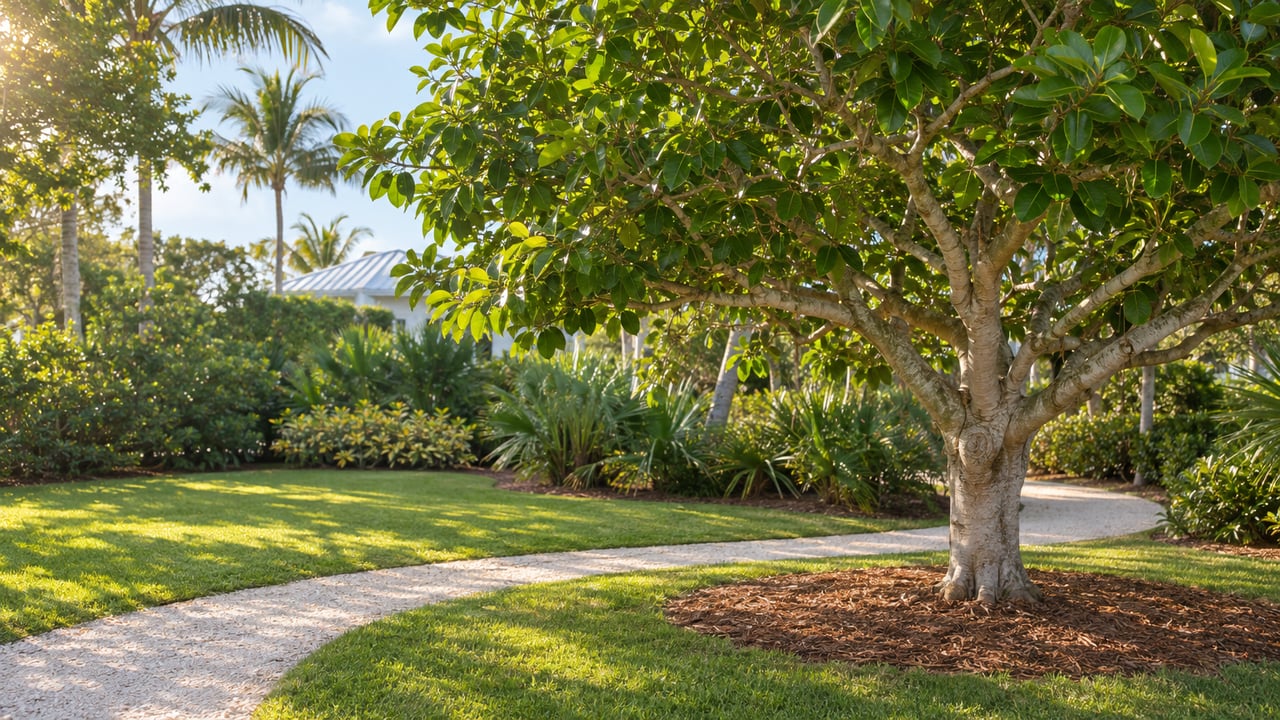
The tree that started everything is in that planting. GICIA's May 2025 update described a 20-foot specimen banyan. A year later, the Boca Beacon described the same tree as a 25-year-old specimen planted near the fire station, with Yellow Elder among the newer flowering plants around it.
When GICIA announced the Banyan Street project in October, it named that tree as the starting point. In the association's words, published in the Boca Beacon, the Town Park banyan went in successfully "last summer," and afterward the organization "began exploring whether Banyan Street could be restored with large specimen trees." Banyan Street has the bigger story, but the tree by the fire station was the test that made it possible.
Why both trees needed reliable water
The fire station banyan had something going for it. The Beacon quoted GICIA Executive Director Misty Nichols explaining that the association felt comfortable planting large trees in the Town Park "knowing that we had successfully used a well for irrigation in the town park since 1985."
The 2025 drought made that well less dependable. GICIA's arborist advised that the park's plantings needed a more consistent water source. GICIA asked the Gasparilla Island Water Association to install new water meters in the downtown section of the path. Ron Bolton, the water association's executive director, told the paper that the island's old shallow wells, which draw from what he called the "surficial aquifer," had been badly contaminated with salt during Helene and Milton.
Banyan Street was planned with the same problem in mind. Lee County's Department of Transportation committed to extending irrigation from Gilchrist Avenue to Banyan Street and to keep watering the new trees afterward. Crews were laying that irrigation the first week of November, a few days before the trees arrived. Saltwater killed the old trees, so getting freshwater to the new ones was the first job on both sites.
Fourteen trees, about 200 miles
Banyan Street was once called Second Street. Around 1915, landscape architect Carl Rust Parker drew up a plan to line it with banyans. Over the following century those trees grew into the canopy that made the street a favorite backdrop for photographs and weddings. Hurricanes Charley and Ian did damage, but the 2024 floodwaters from Helene and Milton were worse. Of the 22 original banyans still standing, 14 were lost. According to the Beacon's November 5 report, the original plan called for 13 trees on each side of the street. After the storms, people hoped that trucking in freshwater would save the century-old trees, but it didn't.
Rick Joyce, a certified arborist and consultant to GICIA, searched South Florida for replacement trees and found all 14 at Becker Tree Farm. He said they are about 25 feet tall and were grown to develop the prop roots that give a mature banyan its look, and that each weighs between 8,000 and 9,000 pounds. The move required seven flatbed trucks with wide-load escorts for a trip of nearly 200 miles, plus a crew from Juniper Landscaping to unload and plant them.
A few details only show up close. Each tree was grown in a wooden box. The bottom of the box is untreated wood, so it was left in the ground. Banyan roots are shallow, and the new holes were placed to follow the street's original layout. Lee County DOT did the hardest site work. It removed the 14 dead trees and was still pulling stumps the week GICIA announced the project in October. GICIA paid for the trees from privately raised funds. In October the association put the total cost to buy, move and plant all 14 at just under $400,000. GICIA President Bruce Carbonari said member support over the years meant the project could go ahead "without launching a special fundraising campaign."
Beacon editor Garland Pollard predicted in an October editorial that the replacement banyans "will be a tourist attraction on their own." Nichols has been careful about expectations. "We know these trees will not recreate that magnificent canopy overnight," she said in the October announcement. "It will take years for them to grow together, which is what makes this a true legacy project."
Orchids on the same walk
There is one more thing to look for on the walk back to the Town Park, and it's small. Over three days that ended on a Monday in late July or early August, a team from Fairchild Tropical Botanic Garden in Miami planted 767 orchids through Sam Murphy Park and along the GICIA Bike Path. The Beacon reported it on August 6. The work is part of Fairchild's Million Orchid Project, which aims to reestablish one million native orchids in South Florida and had propagated more than 700,000 when the article ran. GICIA's July announcement had planned for about 1,000 orchids and named the Town Park and Sam Murphy Park as planting sites.
Three species were planted: the Florida butterfly orchid, Encyclia tampensis; the night-fragrant orchid, Epidendrum nocturnum; and the Florida dancinglady orchid, Oncidium ensatum. They are attached to trees and left to establish on their own over time. The May article that announced the new water meters ran a photo of a native butterfly orchid already growing on the path. Fairchild's Jason Downing told the paper that growing orchids sustainably and putting them in public places "reduces the value in the black-market orchid trade." The same August report said students at The Island School were growing native orchids for future plantings on GICIA's island properties.
The rest of the path
All of this sits on a much larger restoration. In the 2025 season, GICIA removed nearly 400 mature trees along the Bike Path that saltwater had killed. Replanting all five miles took almost 14,000 trees, shrubs and grasses. GICIA used only salt- and drought-tolerant plants, following its Bike Path Master Landscape Plan. Gifts from two island families covered $1 million of the estimated $1.3 million restoration. GICIA finished replanting the section from 1st Street to the north end in late November 2025, about four months of work at a cost of nearly $1.1 million. This July, GICIA announced another $25,000 of native trees and grasses for the path. In that announcement, published by the Boca Beacon, Bike Path Committee chair Fred Pierce said the extra planting was meant to help the landscape keep maturing after the previous year's severe drought.
The ground under it all has its own history. The Charlotte Harbor & Northern Railroad ran here from 1907 to 1979. In 1983, the Bayard and Hugh Sharp families traded property for the CSX track bed from the north end of the island to First Street and gave the land to GICIA, along with money for its upkeep. The path opened on February 23, 1985. It is five miles long, averages 75 feet wide and covers 35 acres.
For the short version of the walk, park in one of the Town Park's shell cart spaces, find the banyan near the fire station, and then walk over to the old Second Street to see the 14 trees that followed it. For more on the streets around them, see our guide to Boca Grande's most iconic streets and our Historic District neighborhood page.
Banyan Street's canopy will take years to fill in again. If you want to talk about life in the Historic District, or about the blocks around Banyan Street and a home you own or are considering there, reach out to Maryjo Pigott. Schedule Your Free Consultation.